Posts

Dan the Diver joins STEM Club

Image
  Legend has it that Dan the Diver was born in a giant clam shell many years ago when, along with trochus and tritons, these shells were being collected in large numbers and someone needed to speak up for them. We now know that babies aren’t born in shells. His mother had told him stories about a boat called the Northern Star and its days in the trochus fishing industry. It roamed the Reef from north of Cooktown to south of Mackay looking for shells from which to make buttons. As a baby, Dan learnt a lot about trochus fishing from his Uncle Albert, who had spent his entire life diving for these shells in Torres Strait and down the east coast of Australia. He had even been on the Northern Star with the notorious skipper Bully Hayes. On one trip, the skipper ended up on top of the reef. Luckily, the boat floated off next high tide. The shell landed in Cairns was 18 tons and was worth £4680 in the early 1950s. As you can see, this story could have ended up very much differently. Bully...
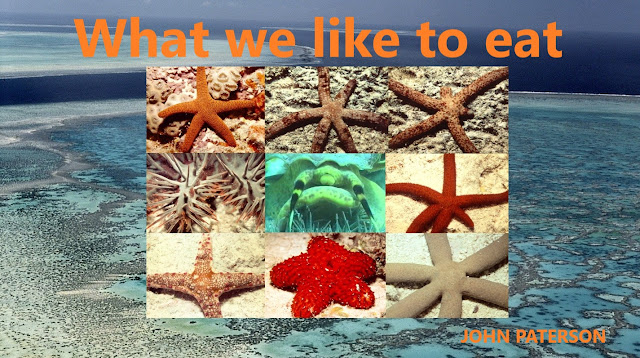
What we like to eat.

Image
  Prey Preference It all depends on what we like to eat or maybe not. ”I’m going to put all you starfish in a cage with Triton and see which species get eaten,” said Dan the Diver. “That should tell us its prey preference. What could possibly go wrong?” “It all depends on what we like to eat,” said Triton “but remember that these starfish are poisonous, so leave them for me. One is even venomous, so don’t touch them unless you know the difference.” “I don’t mind eating you Elegant Starfish,” said Triton “but you are not much of a feed”. I know how to deal with your poisons and armor but unless I am very hungry, I wouldn’t bother.” “You both know what to do,” said Triton “you stay out of my way. You even hide under coral rubble in the shallows. Now-a-days, I stay away from there as divers and shell collectors love me for my shell.” “If I eat one of your arms, you will just grow another,” said Triton “You can just cast them off and get away. You hide under rubble in the shallows as w...

Don't Blame Me

Image
“Don’t blame me,” said the little boy. “The problem with our oceans is that they’re huge.” “That’s what I’ve been telling them for 60 years,” said Paddy the Starfish. “I’m just a baby, so don’t blame me” said Junior to Bubbles the slug. “The problem is up there”. “Something must have changed, but what was it?” said Angel Fish. “I suspect lots of things”. “I know that you’re talking about me,” said Thorny passing by quickly for good reason. “I know that you’re here somewhere, Thorny” said Dan the diver. “You can’t outrun me”. “You won’t get away next time Thorny,” said Triton. “Your days are numbered”. “That’s all right for you to say Triton,” said Nudibranch. “You have a shell and lots of food”. “And the more often Thorny gets away, the hungrier they are for me,” said another starfish. “I might only be a shrimp, but I can look after myself when it comes to Thorny,” “I don’t mind a Thorny or two,” said the Wrasse. “It’s really a question of what we like to eat.” “What do you mean by tha...

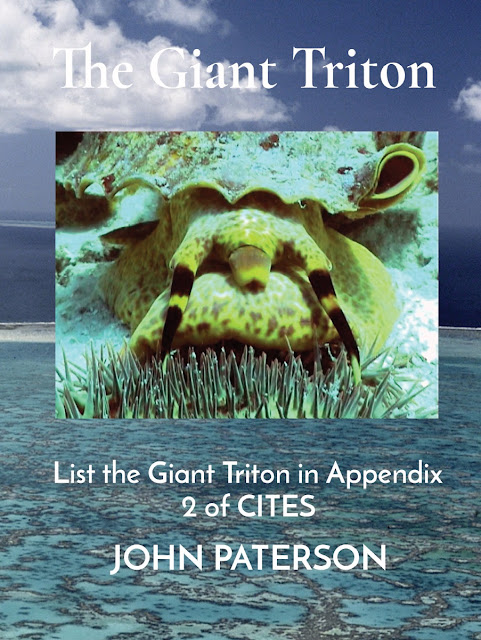
The Giant Triton: List the Giant Triton in Appendix 2 of CITES

Image
  While the giant triton may be protected on the Great Barrier Reef and elsewhere in Queensland, there is still no evidence this protection has resulted in restored populations of the giant triton. However, there is evidence of continuing illegal collection and trade in Indonesia where it is also legally protected. It is now worth reconsidering whether the existing local protection is sufficient or whether further international protection is required by listing the Giant Triton in Appendix 2 of the Convention on International Trade in Endangered Species (CITES). The giant triton ( Charonia tritonis )is a beautiful shell and a well-known predator of the crown-of-thorns starfish ( Acanthaster planci ). In many parts of the third world, it is still being collected in large numbers and sold to tourists as ornaments. As you admire the beautiful shell, spare a thought for the hungry mollusc that died. And don’t forget, they live on starfish. Many species of starfish are known to outbreak...

Charonia Research Digital Collection New

Image
  Miyake-Jima 1957 It's 1957 and Japanese scientists travel to the island of Miyake-Jima to study a strange disease affecting a coral reef. The island’s people have noticed a strange increase in the number of the large, venomous crown-of-thorns starfish. Over the following years they kill large numbers of the starfish attempting to protect the living coral upon which the starfish is feeding. The Japanese scientists noted that they had observed giant triton shells feeding on the crown-of-thorns starfish, in research published only in Japanese. 5 years later This same species of starfish is noticed in increasing numbers at Green Island, off Cairns here in Australia. Over the next five years, the starfish outbreak will consume much of the living coral at Green Island and other reefs in the vicinity. The giant triton is again observed feeding on crown-of-thorns starfish and research in Queensland is commenced on the feeding rate and prey preference of the giant triton. Tests ar...

Charonia Research Digital Collection

Image
 

Chatting with ChatGPT: The Collection 1

Image
PDF and Epub  and Audiobook available for free download from  Internet Archive